

There is something disorienting about the current AI moment. For a long time I haven’t quite been able to put my finger on it:
AI is astonishingly capable. It is also astonishingly unreliable.
We can produce more code, content and answers than ever before, but it isn’t obvious that we’re producing more value.
The cost of producing an answer collapsed, while the cost of knowing whether it’s the right answer hasn’t.
We are pouring extraordinary amounts of capital into increasing AI capacity, while still struggling to measure the economic value created by the capacity we already have.
This is not an essay about an AI bubble, although I’m confident we are living through one. It is also not an essay about whether generative AI is real or hype, whether coding agents actually work, whether AI will or will not replace software engineers. And it’s certainly not another productivity essay on how to make developers 10x faster.
What this essay is about is trying to make sense of the weirdness through the usual Hagakure lens: complexity and systems thinking. Because one thing is undeniable: generative AI is creating extraordinary abundance.
Capital (for AI) has become abundant.
Code has become abundant.
Content has become abundant.
Answers have become abundant.
Ideas have become abundant.
And yet there is something strange about the way we talk about all this abundance. We tend to only look at the point where it occurs.
A developer builds in twenty minutes what previously took three days. A company triples the number of pull requests its engineers merge. An AI lab serves exponentially more tokens. Nvidia sells another extraordinary number of GPUs. Another few billion dollars are committed to another data center.
These are real. But they are also local observations inside much larger systems. And systems have outputs of their own. So perhaps the more useful question is not simply what happens when something that used to be scarce becomes abundant. It is:
What happens to the output of the whole system when one part of it suddenly becomes abundant?
Where did the scarcity go?
From a systems perspective, increasing the capacity of one part of a system does not necessarily increase the output of the whole system by anything like the same amount. It’s just not how the world works.
Think of a restaurant with a kitchen suddenly capable of producing ten times as many meals. The kitchen really has become 10x more productive. That’s not fake productivity. But the restaurant doesn’t serve ten times as many customers if tables, waiters or demand haven’t changed.
The distinction sounds obvious when stated like that. Yet I think we’re constantly making versions of this mistake with AI.
Which brings us to software engineering.
Did “software engineering” become abundant? Code certainly seems to have become abundant. I’d suggest an even narrower claim: the ability to produce plausible code from an explicit description has become radically cheaper and faster. That’s extraordinary and I think it’s an important distinction.
Code may be the most visible artifact of software engineering. Software engineers have historically spent a lot of time thinking about it, writing it, reviewing it, fixing it. Founders and executives have historically spent a lot of time hoping all of that went faster. But by conflating code with software engineering we are implicitly treating the system as:
requirement → engineer writes code → value
Whereas the real system tends to look more like:
understand problem → decide what to build → specify behavior → design system → implement → verify → integrate → deploy → operate → maintain → observe user behavior → learn → repeat
Suddenly, code generation is but one node in a much larger system. I think this simple fact is where much of the current conversation about AI productivity starts going off the rails.
The developer who used to spend three days implementing something and can now do it in twenty minutes has experienced an enormous productivity improvement. If her team starts merging twice as many pull requests, that’s real too. If the company can now run three times as many experiments or ship twice as many features, still real. But follow the chain all the way through:
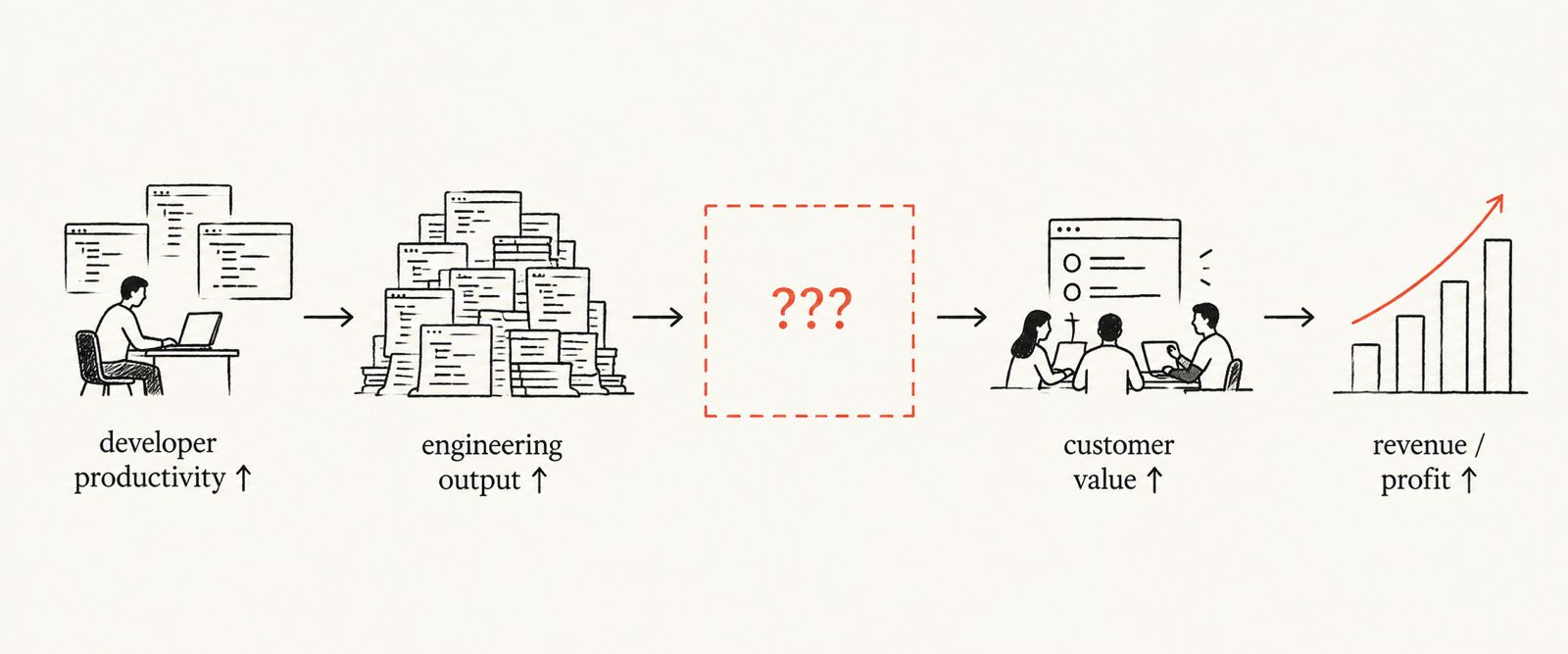
What happens inside those question marks? Because there is no law of nature saying that a 5x increase at the beginning of that chain produces a 5x increase at the end of it.
In fact, easier and cheaper code production doesn’t simply “move the bottleneck”. It carries the potential to change the whole system, in large part because people respond to abundance. And somehow abundance is easily mistaken for something that is always and undeniably good:
PMs can run more experiments? Great!
Engineers can do more refactoring? Amazing!
Customers can get more features? Awesome!
Everyone can build software now? Sign me up!
The trap is assuming that because the marginal cost of an activity fell, doing more of that activity obviously improves the output of the system it belongs to.
It doesn’t.
The benefits are immediately visible where the abundance occurs; what happens to the rest of the system is much harder to see.
The person generating code experiences the benefit immediately: something that used to take three days now took twenty minutes. The cost might appear six months later in maintenance. Or in another team integrating against it. Or with the customer navigating a bloated product. Or with security. Or simply as thousands of technically feasible things competing for limited organizational attention.
And even if none of those costs materialize, another pesky question remains:
Did the customer actually get more value?
Did they buy more? Stay longer? Pay more? Did margins improve? Did revenue per employee increase? Did any of that additional engineering output eventually show up in profit or cash flow?
These are much less exciting questions than “look what I built in twenty minutes”. They’re also much harder to answer.
But output at one node of a system is not the output of the system.
When saying yes gets cheap
AI also removes friction from doing. So you do more. Generate more. Explore more branches. Run more iterations. Ask more questions. Read more output. And everyone else around you is incentivized to do the same.
(“It’s been amazing but I feel more drained than ever.” Sounds familiar?)
This is where the scarcity question becomes useful. As production capacity becomes less scarce, the capacity to evaluate, choose, integrate and stop becomes relatively scarcer. So does the judgment necessary to decide what not to do.
Paradoxically, production scarcity itself has historically acted as a crude “allocation mechanism”. Engineering capacity was expensive, therefore you couldn’t build everything. Organizations had to prioritize. “Is this worth three engineers for six weeks?” was a forcing function. Often a shitty and frustrating one, to be sure, and companies still built plenty of nonsense. But it imposed a cost on saying yes.
In other words, the scarcity of engineering capacity didn’t only slow production down. It also forced companies to choose.
Now we’ve dramatically reduced that cost and it feels incredible. It’s almost like we’re off the hook—no need to prioritize anymore. Those hard conversations? Gone. We can do so much more now.
Except that’s mistaking activity for value. “What’s valuable?” remains an important—and hard—question to answer. We can’t simply fall back on our ability to measure value or ROI. We’ve always been mediocre at that, largely because it’s genuinely hard to do.
The pickle is that good selection requires something much harder (and scarcer) than generating code: understanding what users need, what the business values, how the system behaves, what tradeoffs you’re making, what future complexity you’re accepting, and what evidence would tell you whether the thing was worth doing.
And none of those things became abundant just because code did. They’re part of what sits inside the ??? we saw earlier, between more output and more value. They determine whether abundant production actually propagates into value.
The feedback arrives late
There’s another problem hidden inside those question marks: time.
The system learns almost immediately that it can produce more. It learns much later whether producing more was actually worthwhile.
The fast signals are obvious: something took 20 minutes instead of three days; PR count rises; experiments increase; features ship faster.
The slow signals are things like whether customers actually use the feature, whether retention moves, whether complexity accumulates, whether maintenance becomes painful, whether margins improve. Those can take months.
Because organizations are made up of human beings (yes, still), they tend to respond to what they can see. If the visible signals say “this is working”, the rational response is of course to do more of it. More AI tooling, more automation, more experiments, more output. So the system starts expanding on the basis of fast, local evidence before the slower, system-level evidence has arrived. Interestingly, the fast signals also raise the bar the slow signals will later be judged against.
Why does this matter? Because when the signals encouraging expansion arrive quickly, while the signals telling us whether that expansion was justified arrive slowly, systems are prone to overshoot.
By overshoot I simply mean that the system can expand beyond the level that later evidence turns out to justify. And it’s important to note two things:
Overshoot does not require stupidity. It can emerge from perfectly reasonable actors responding to incomplete feedback.
The delayed feedback isn’t always negative. Overshoot doesn’t always lead to some collapse. Sometimes the right thing to do actually was done. The point is that you don’t know yet.
You might be thinking that this has always been true, and I would agree with that. AI didn’t create this feedback delay. It widened the gap. It dramatically accelerated our ability to act, while many of the signals telling us whether those actions created value haven’t accelerated nearly as much.
We have so far been using software as an example to understand the system dynamics but let’s now look at how the same structure appears at a larger scale.
Same question marks, larger scale
I promised this essay would not be about an AI bubble and I intend to keep that promise. But it’s worth zooming out from the software team to the AI economy itself as it shows us exactly the same dynamic at work.
Here’s a (somewhat simplified) macro chain for it:
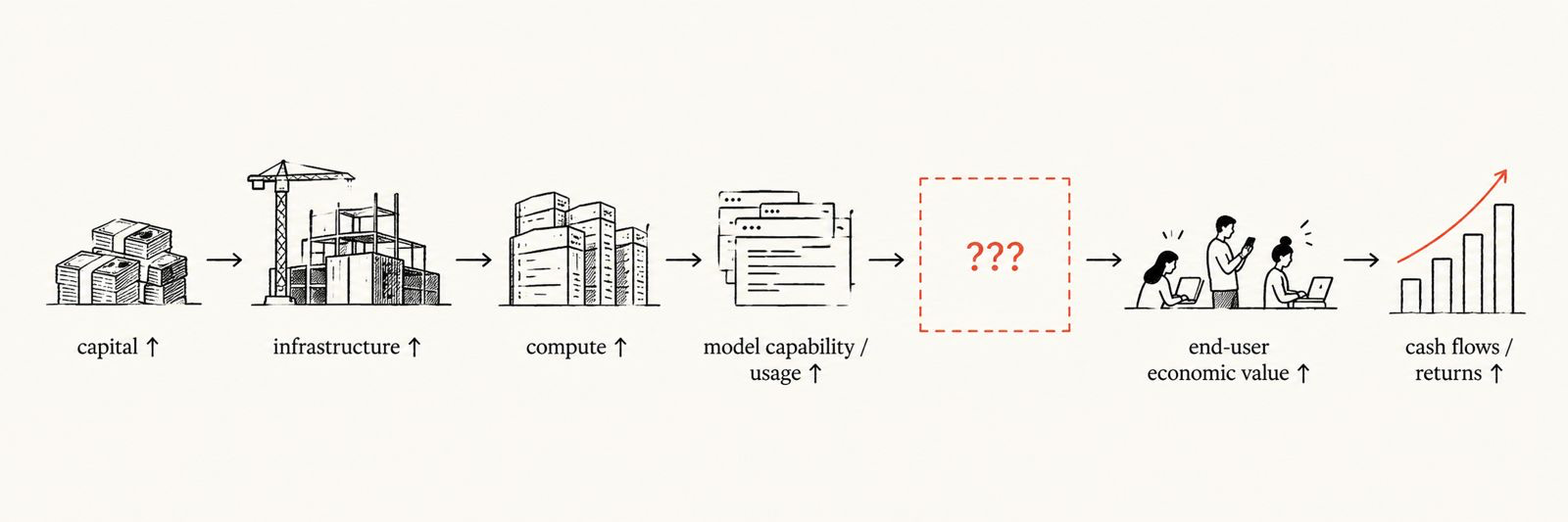
We’ve seen those question marks before. If we try to unpack them, we realize that for usage to lead to end-user economic value it probably requires things like:
model capability / usage ↑ → enterprise adoption → workflow change → customer value → willingness to pay / cost savings → cash flow
And when we zoom in on “customer value” we’re right back at the level of analysis of the previous section—the slow, uncertain, difficult parts of product building. However, remember how we pay attention to what’s visible? What’s visible looks more like this:
expectations ↑ → capital availability ↑ → buildout ↑ → supplier revenues/order books ↑ → perceived validation of AI demand ↑ → expectations ↑
But demand at an intermediate node isn’t the same thing as terminal demand. Ultimately, spending at the far end of the chain has to be supported by economic value created for enterprises or consumers. The slow feedback loop looks more like:
enterprise adoption → workflow change → economic value → cash flow / realized ROI → willingness to invest more → further adoption
The important difference is speed. The upstream system can respond to orders, revenue and investment almost immediately. The downstream validation of whether all that capacity created enough economic value takes much longer. As we have seen before, that gap is what makes overshoot possible.
The asymmetry becomes stark
If this model is right, we should expect the clearest and fastest-growing numbers to appear where the feedback is fastest. And that is pretty much what we see in the AI economy.
The upstream boom is unmistakable and the numbers are staggering. Nvidia did $96.2bn of quarterly (!) revenue, including $89bn from Data Center, +117% YoY. Alphabet expects $195–205bn of 2026 capex; Meta $130–145bn. AWS says its specifically identified AI business has passed a $25bn annual revenue run rate.
We also observe that demand exists further downstream, but much of the capacity commitment is concentrated in a few intermediaries and is explicitly forward-looking. OpenAI is approaching a $70bn ARR, while Anthropic did $4.6bn of 2025 revenue and is reportedly running toward roughly $40bn in 2026. Interestingly, Ed Zitron, synthesizing estimates from several bank analysts, argues that 70% or more of Microsoft, Google and Amazon’s AI revenue may come from OpenAI and Anthropic alone.
The labs clearly have real customers. But where it gets interesting for the purposes of our conversation here is that their compute commitments are vastly larger and much more forward-looking than their current revenues. Anthropic has roughly $417bn of long-term hosting/compute commitments; OpenAI is reportedly targeting around $600bn of compute spending through 2030, including a reported ~$300bn Oracle contract.
Why?
Because a large part of today’s upstream AI demand is demand from intermediaries that are themselves making enormous bets on future terminal (aka end-user) demand.
Add to that the incentives to not blink—nobody wants to underinvest while fast signals keep validating expansion, and risk being left behind—and you have things like Alphabet and Amazon investing in Anthropic while selling it compute; Broadcom financing Anthropic’s capacity purchases; or Nvidia and other ecosystem players investing in AI companies that in turn buy their infrastructure.
This is where parts of the financing start to look circular. Not fake, nor illegal. But driven by the fast feedback loop well before the slow feedback loop can eventually say “enough”:
The hyperscaler gets a multibillion-dollar commitment now.
The data center gets financed now.
Nvidia/Broadcom gets an order now.
The market sees AI demand now.
Whether enterprises and consumers eventually create enough value to make the labs’ commitment economically rational is discovered later.
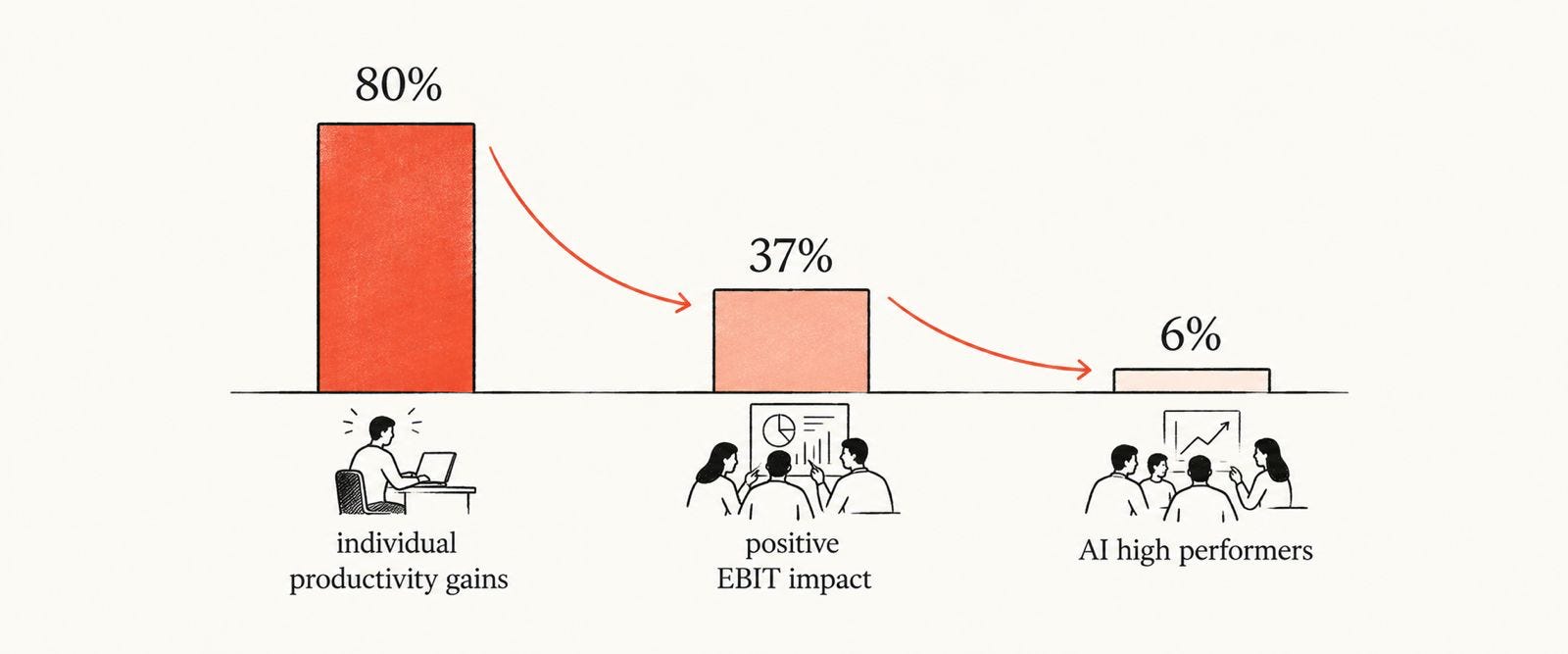
According to McKinsey, 80% of respondents reported individual productivity gains from AI. But only 37% (down from 39% in 2025) attributed any positive EBIT impact to it, and just 6% (flat from 2025) qualified as high performers with significant impact and at least 5% of EBIT attributable to AI. And this over a year in which worldwide AI spending was forecast to grow on average 47%.
It’s almost comical how well this illustrates the chain we have been circling around:
local gain → ??? → system value
To put a bow on this part of the discussion and as a passing comment on the magnitude a system at this scale can overshoot, let’s briefly look at the hurdle that all of this AI infra investment has to clear.
BCG estimates roughly $5tn of AI capex from 2026–31. On its assumptions, that requires about $1.6–2.0tn of annual AI revenue to cover depreciation and earn a 10% pretax return versus roughly $100bn today.
To put this in more relatable terms, Ed Zitron has framed the hurdle as Amazon effectively needing another AWS, Microsoft another Azure, and Google a new business line at least half the size of Search. All at the same time.
Let that sink in.
As we now understand, the point is not that this revenue cannot possibly ever materialize or that “AI sucks”. It is that enormous commitments are being made before anyone can know whether it actually can, because the fast feedback is already strong enough to justify continued expansion. That’s how overshoot happens.
When reality calls
So what happens if the slow feedback eventually arrives and says: too much?
That’s when the fast loop can quickly reverse:
expectations weaken → capital gets harder/more expensive → projects are cancelled → supplier growth slows → expectations weaken further.
Notice, however, that the investment cycle can break without the technology breaking. Excess compute becomes cheaper, infrastructure survives, weaker companies disappear, useful applications keep spreading. That story is not new—variants of it happened with railroads, fiber and the internet at different points in history.
And the software development version of a similar reversal:
realized value disappoints → projects get killed → roadmaps shrink → selection tightens → complexity gets pruned → output falls
The software analogue of “excess compute becomes cheap infrastructure” is also interesting: the coding capability remains. Teams don’t go back to hand-writing everything. They simply learn that abundant code generation is only useful when paired with much stronger selection, verification, architecture and product judgment.
In both cases, the correction doesn’t remove the new abundance. It forces the rest of the system to learn how much of it it can actually absorb productively.
Seeing the whole system
If you, like me, have been feeling that this AI moment is strange and disorienting, I hope this essay has to an extent made it less so.
Yes, AI can be so capable as to feel almost magical. Developers can produce so much more and non-developers can now create software as well. Virtually no question goes unanswered anymore. Infrastructure has grown explosively. And yet, whether all of that translates into commensurate system-level value remains remarkably unclear.
But as we saw, those things are not contradictory once we realize that output at one node is not the output of the system. More code is not necessarily more useful software. More AI usage is not necessarily more enterprise value. More compute is not necessarily more economic value. More capital invested is not necessarily more return.
So, in closing, perhaps what leaders at all levels should be asking are questions like:
What is the system actually trying to produce?
Where is value being measured?
What constrains its propagation?
What actually sits inside the fuzzy
????And how long does the feedback that tells us ‘enough’ take to arrive?
The interesting question is no longer how much more we can produce but whether that abundance actually makes it through the system.
And if this is how the system behaves, what kind of leader does it require?
This was a great read. Thanks for sharing Paulo!
Thanks for sharing Paulo, interesting and thorough article. Agree with a lot of what you’re saying: equally it seems as CEO you have 2 choices: hoard cash and don’t invest in AI; or go full throttle on AI. I’d say it’s easier to do the former if you’re an established company; and you MUST choose the latter if you’re a challenger, since it’s the biggest potential angle of attack you have.
From my POV a few observations:
- The forcing function in my opinion has never been a company having limited resources and being forced to choose wisely due to limited engineering resources: it has always been whether ultimately a customer derives value from the product. Choosing to prioritise correctly just means you chose to build what the customer wanted. I would argue it’s now easier to iterate to get to that point. Because every company can build quickly, what remains is still whether you make the right decisions and build the right thing for your customer as it always has been.
- I think it’s important to mention that AI doesn’t just impact software engineering but also other information processing and design jobs. For example, we found Opus 5.5 on Max in Code can essentially generate 90% of our pitch decks, which can take hours of manual work. That doesn’t mean you win more pitches or grow as a business, by the way, but it does mean that producing a good pitch is increasingly becoming table stakes (currently still not as we are in transition). Which means you NEED to have the capability in place so you can redeploy your efforts and time into activities that differentiate and are margin-defending/protecting - ie actually grow your business. That still comes down to good strategy and execution: but AI creates new openings for you to attack the market in ways that were previously not possible.
- The EBIT question is a difficult one currently: you need to pay to partake in the AI transformation and experiment to find use cases. That experimentation also damages the bottom line, so any potential margin improvements can quickly be eaten up by that. You wouldn’t expect that to hold indefinitely, though.
- I think the smallest companies have the greatest chance of showing real AI productivity gains vs enterprise, simply because their ability to move fast. I’d look there, first, for potential proof points. Btw there is real US productivity growth surging last few years (2.6% vs 1.5% for the decade). No way to prove AI is driving this, but good to keep an eye on.